

Scientists have discovered a mathematical law that determines the shape of bird beaks.
Scientists have discovered a mathematical law that determines the shape of bird beaks.
Few things can compare to the fascination of observing a bird's beak. Some beaks are long and thin, like a straw; others are short and curved, like a hook. Many people stop in their tracks before hummingbirds or flamingos, admiring their coloring and grace alone. But what if, behind all this diversity of shapes, lies a single mathematical law that shapes each of these beaks? A team of researchers has proven just that, and their discovery links modern birds soaring above our cities with the dinosaurs that dominated the Earth more than 200 million years ago.
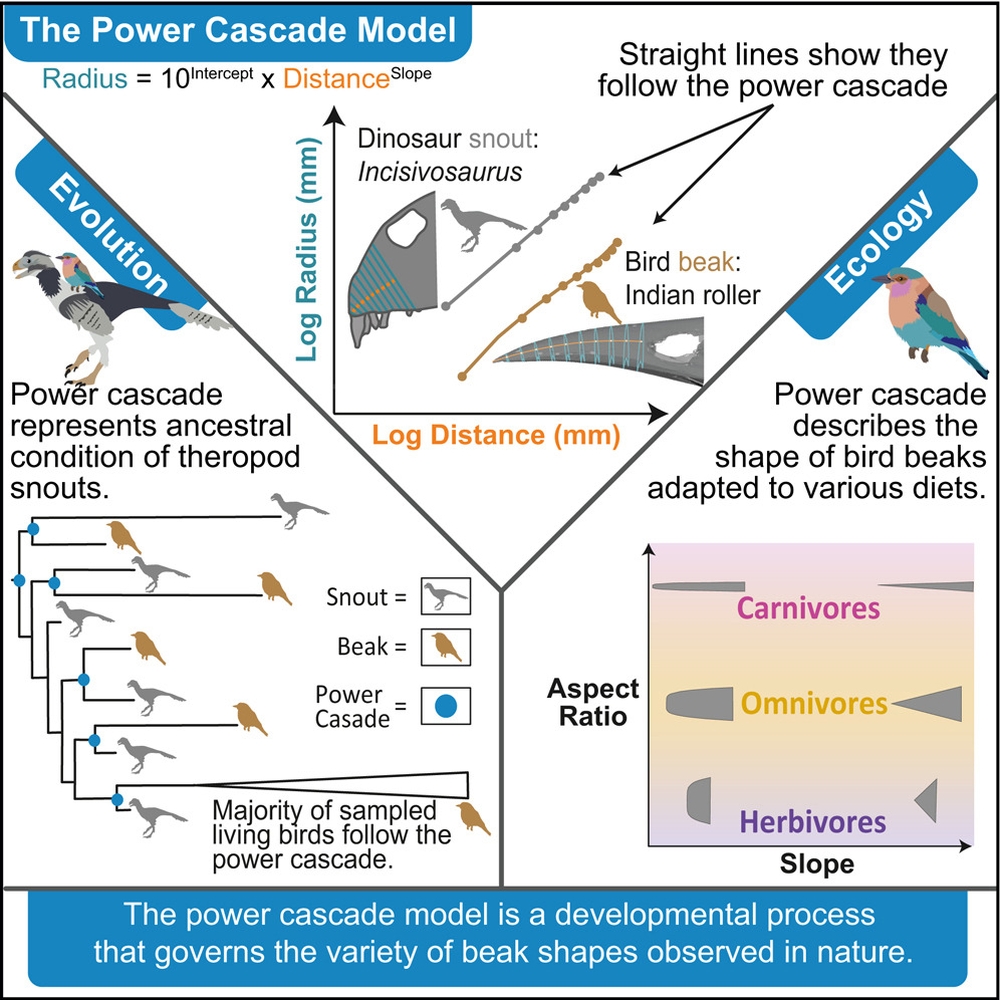
A scientific paper in iScience contains a startling discovery: it turns out that the beak shapes of virtually all modern birds and many extinct theropod dinosaurs evolve according to a single mathematical law. This principle, called the "power cascade," describes with geometric precision how the beak is formed—from a sharp tip to a broad base. A study by Kathleen Garland and Alistair Evans sheds new light on the evolutionary mechanisms that, over millions of years, created the astonishing diversity of dinosaur faces and their feathered descendants.
Geometry that endured millions of years
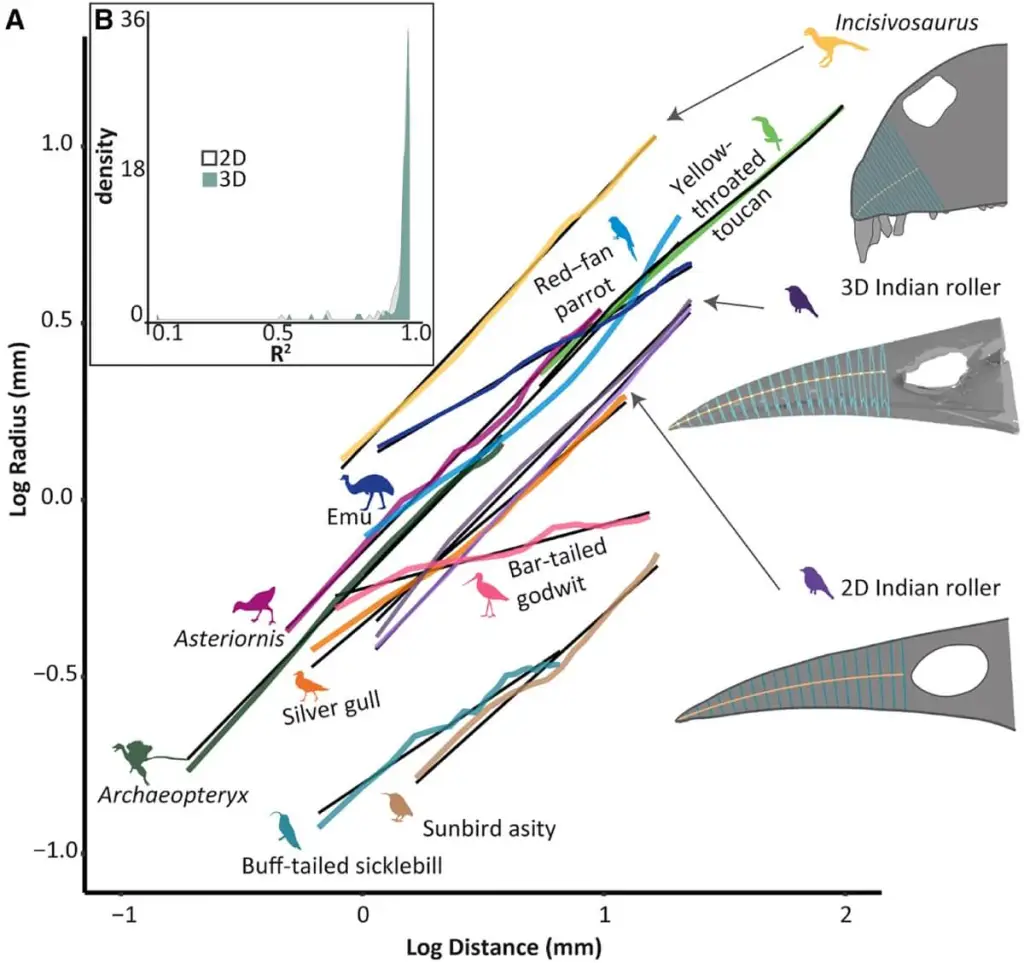
The researchers carefully studied 127 species: 106 modern birds and 21 fossil theropod dinosaurs. They systematically analyzed the shapes of their beaks and faces using a geometric model called the power cascade. This model is based on a simple yet powerful principle: the ratio of the beak width to the distance from its tip forms a straight line on a logarithmic scale. As the paper notes, "the power law model describes a log-linear relationship between the radius of the beak and the distance from its tip".
But this isn't just a visual coincidence. It's a specific mathematical way of describing the growth of pointed structures in living organisms—a principle that applies not only to bird beaks, but also to teeth, horns, claws, and shells. In other words, the geometry that governs beak formation is found in other parts of the animal body.
The most surprising thing was that this formula applies equally well to fossil theropods — both beaked species and those with toothed snouts. Ninety-five percent of the studied species strictly followed this growth law. As the study states, "the shape of theropod beaks and snouts reliably follows a power-law model".
This discovery not only links dinosaurs to modern birds but also demonstrates that evolution often operates according to universal mathematical rules.
What Shape Reveals: A Look Back
The study didn't simply confirm that the model fits most species. The scientists also tested whether this rule existed in common ancestors. To do this, they constructed a phylogenetic tree and estimated the R² (goodness of fit) of the model. The result was unambiguous: all tree nodes, including the oldest, had an R² value above 0.90. This means that even early theropods likely retained this growth principle.
This leads to an important conclusion: the power-law relationship may reflect the most ancient method of snout formation in all vertebrates. As the article states:
"The power-law relationship represents a fundamental pattern of snout growth in theropods—and perhaps in all vertebrates."
Why is this significant?
1. Evolutionary conservation — the model has persisted for millions of years, despite radical skeletal changes.
2. Universality — if the hypothesis is correct, this principle may even apply to mammals and reptiles.
3. The connection between development and evolution — growth constraints guide adaptation but do not preclude diversity.
This discovery changes our understanding of how deep biological laws shape visible differences between species.
Diet, Function, and Variation
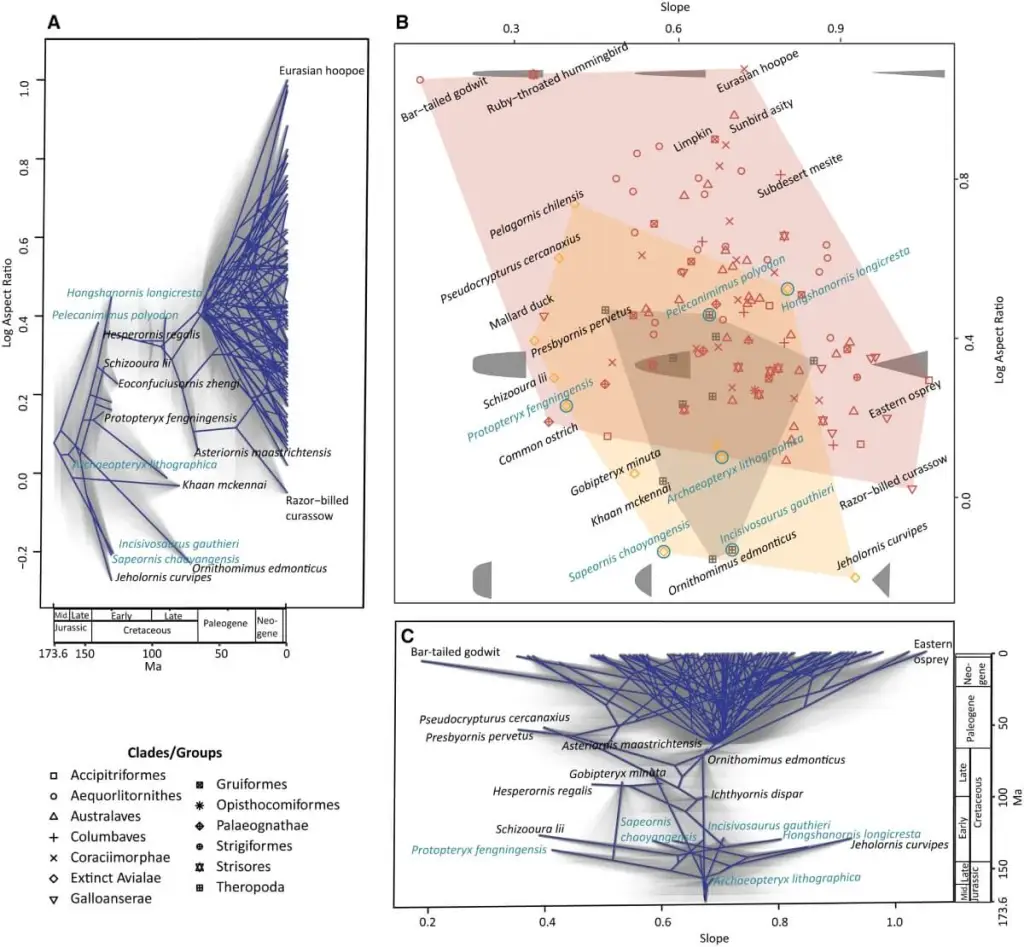
The study also examined how this mathematical law is influenced by the ecology of modern birds. Diet, habitat type, and foraging method were analyzed. Although most birds follow this rule, their bill shapes vary within the geometric model depending on their diet. For example:
- Raptors typically have narrower bills (high aspect ratio),
- Herbivores tend to have more robust bills (low aspect ratio).
One of the key parameters of the model — the logarithmic aspect ratio — showed a clear link with diet type:
"The logarithmic aspect ratio revealed a significant split between herbivorous/omnivorous and carnivorous species."
This confirms that bill geometry reflects not only evolution but also ecological adaptations.
Exceptions to the Rule
However, not all species follow this pattern. Among the "outliers" is the Eurasian spoonbill (Platalea leucorodia), whose flat, elongated bill does not fit the power-law model. Scientists believe that such deviations are due to extreme adaptation to narrow ecological niches (for example, water filtration).
Slow but Diverse Evolution
After the Cretaceous–Paleogene extinction event, modern birds (fan-tailed birds) significantly diversified their bill shapes without accelerating the overall rate of evolution. As the study notes:
"The rate of evolution of R² decreased with the emergence of fan-tailed birds."
This means that modern morphological diversity is the result of "exploration" of permissible variants within a common geometric pattern, rather than accelerated speciation. For example, hoopoes and ospreys "filled" the extreme points of morphospace inaccessible to their ancestors.

A Simple Formula for Complex Geometry
Although the article doesn't provide an explicit equation, the growth rule described can be mathematically expressed as a power law:
, where:
-
R is the radius of the beak/muzzle at a given point,
-
D is the distance from the tip,
-
a is the constant (intersection point),
-
b is the slope.
This formula shows how the beak width increases from the tip to the base. On a logarithmic scale, the relationship becomes linear:
This linearity is key: it allows us to compare bills of completely different shapes and sizes within a single geometric framework. Just two parameters accurately describe the morphology of hundreds of species—both modern and extinct.
When breaking a rule makes sense, too
Just because a rule holds 95% of the time doesn't make it absolute. Exceptions help scientists understand the limits of the model.
Striking deviations:
- The hummingbird Archilochus colubris — its slender, curved bill, adapted for collecting nectar, doesn't fully conform to the model.
- The influence of the measurement area — if only the prenasal region is analyzed, the conformity with the rule is higher. When measuring the entire bill, some shapes deviate from the pattern. This is likely due to the influence of other developmental processes (for example, the growth of the nasal openings).
As the authors summarize:
"Power law is a developmental mechanism that creates basic bill shapes, and natural selection acts on them."
Evolution doesn't create forms from scratch — it adapts, refines, or, in rare cases, breaks the general geometric foundation.
Link to the original article:
In order to leave a comment, you need to log in!