

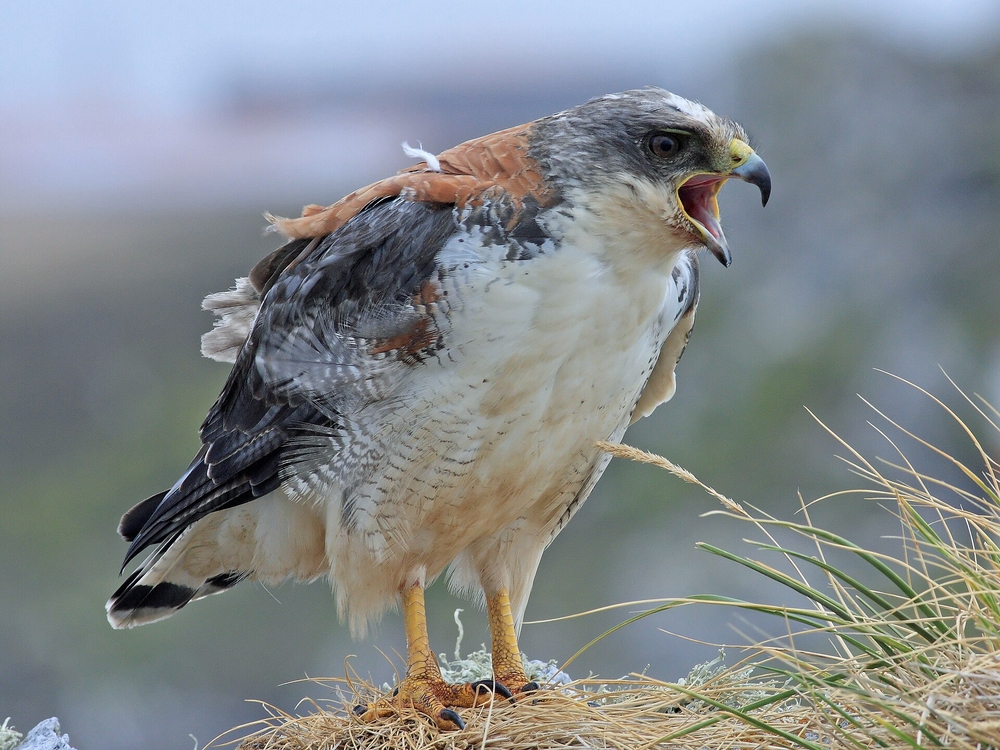
A polyandrous trio of variable hawks
Age, Physical Lesion, and Behavior in a Polyandrous Social Trio of Variable Hawks
Synopsos of the paper
This short communication reports multi-year field observations of a resident polyandrous social trio of Variable Hawks (Geranoaetus polyosoma) — one female and two males — in Tafí del Valle, Tucumán, Argentina (26°47′S, 65°44′W), at 2,630 m asl. The observations span four consecutive austral winters (2022–2025) and form part of a longer 14-winter study (2009, 2011–2019, 2022–2025) totaling 1,033 hours of observation and 2,032 km surveyed on foot within a 12 km² study area.
Individual recognition without marking
Despite the absence of bands or wing tags, the author reliably re-identified the same three individuals across years using high-resolution field photography (Canon EOS 7D Mark II with 400 mm f/4.0 lens) and behavioral observations. Identification rested on:
-
Stable plumage traits (e.g., the first male's persistently whitish underparts, pale axillaries, and faint whitish throat — distinct from other gray-morph males in the area).
-
A persistent physical lesion in the female (left-leg misalignment).
-
Consistent social behavior and site fidelity.

Age determination and molt progression
Age classes were assigned using primary molt patterns (following Howell et al. 2003 and Seipke 2007), exploiting the fact that molt is suspended during the austral winter, so feather generations directly reflect completed molt cycles. The species requires four annual molt cycles to reach definitive basic (basic V) plumage.
-
The female and first male were already in basic V plumage when first documented, indicating a minimum age of 56 months.
-
The second male was first observed in basic III plumage (~32 months old), progressed to basic IV the following winter (showing a bicolored belly from retained rufous and new gray feathers), and reached basic V by 2025.
-
The study reinforces the four-cycle maturation sequence previously proposed for this species and documented in related buteonines (Black-chested Buzzard-Eagle, Bay-winged Hawk).
Polyandrous social structure
The trio formed during the 2022–2023 breeding season (only the first male was present in winter 2022). From winter 2023 onward, the trio:
-
Actively defended a fixed core territory against conspecifics and Black-chested Buzzard-Eagles, using coordinated aerial chases and vocalizations.
-
Soared together daily and were repeatedly seen carrying sticks, suggesting nearby nest-building.
-
In 2025, the two males foraged together in a highly coordinated manner, consistent with cooperative hunting.
-
Tolerated a basic I individual (likely a 2024–2025 fledgling) within the territory.
This extends the documented geographic range of polyandrous social groups in Variable Hawks farther south within the Andes, previously reported only from high-elevation páramo in Ecuador (de Vries et al. 2014).
Physical lesion and reproductive fitness
The female exhibited a visible misalignment of the left leg across three consecutive winters (2023–2025), most likely a proximal tarsometatarsus or distal tibiotarsus fracture; joint luxation or ankylosis could not be ruled out (M. D. Saggese, pers. comm.). She consistently avoided resting solely on the affected leg. Nevertheless, she was observed copulating with the first male on 20 July 2025, indicating that the lesion did not significantly impair reproductive performance despite supporting the additional weight of a 720–770 g male.
Conclusions
-
The observations confirm that Variable Hawks acquire definitive basic plumage after four annual molt cycles.
-
Polyandrous social groups occur beyond the Ecuadorian páramo, extending the known distribution of this behavior southward in the Andes.
-
Multi-angle field photography is a robust, non-invasive tool for long-term individual monitoring of free-ranging raptors, enabling consistent identification across years based on stable morphological and plumage traits.
Keywords
Andes; Variable Hawk; Geranoaetus polyosoma; individual recognition; misaligned fracture.
Source:
Photo by HowardB - Own work, CC BY-SA 3.0, https://commons.wikimedia.org/w/index.php?curid=6026745
In order to leave a comment, you need to log in!