

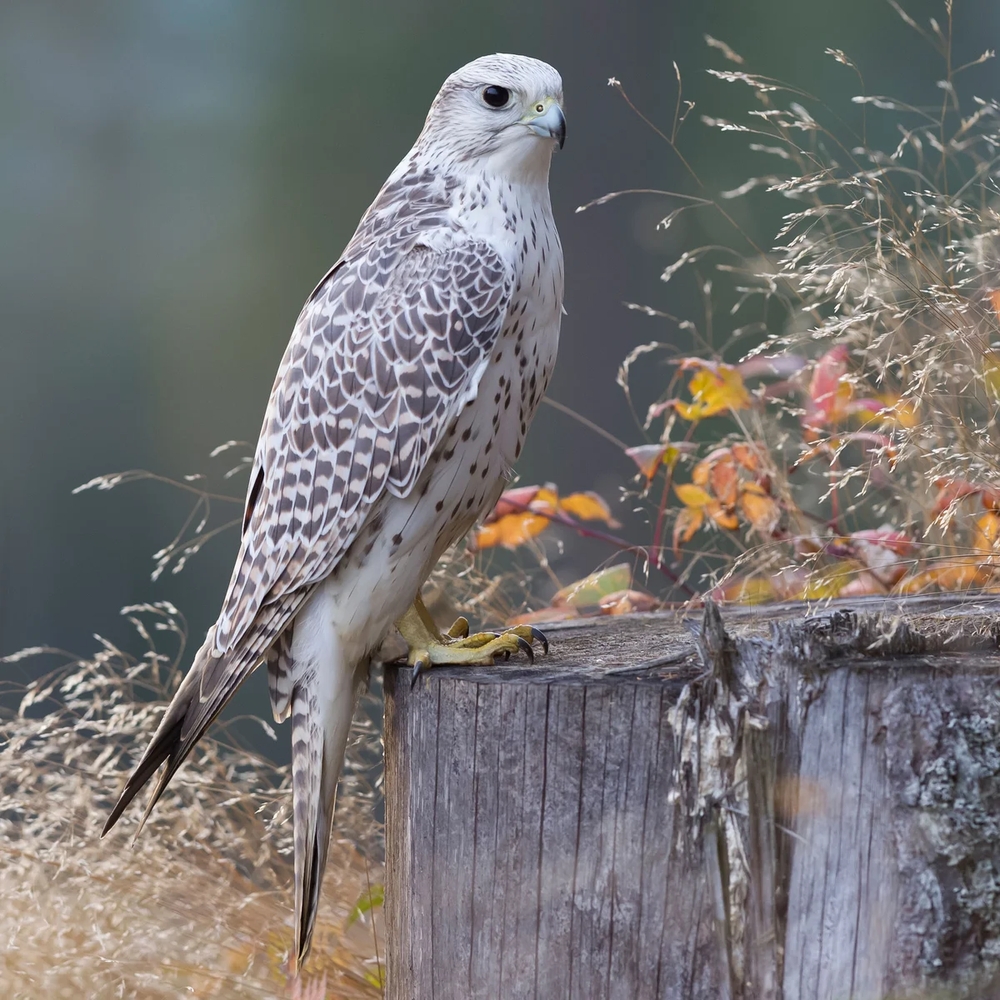
Early spring is the key to success: How gyrfalcons in Yamal survived two different seasons
In 2024 and 2025, ornithologists from the Institute of Plant and Animal Ecology of the Ural Branch of the Russian Academy of Sciences conducted large-scale monitoring of 66 and 69 gyrfalcon nesting sites, respectively, in three areas of the Yamal Peninsula: the Shchuchya River basin, the foothills of the Polar Urals, and on bridges along the Ob-Kara Railway, where these falcons use nests built by crows.
Despite the fact that nest site occupancy was virtually identical in both years (approximately 53–58%), breeding results varied dramatically. While in the cold and prolonged spring of 2024, only 7 out of 15 nests (where the process was known) successfully hatched chicks, in the warmer 2025, this figure soared to 26 out of 29 (89.7%). Nesting success (chicks surviving up to 36 days) was also significantly higher in the second year.
The main reason is snow:
Scientists have discovered that the timing of snowmelt played a key role. In 2025, spring arrived almost two weeks earlier: temperatures consistently dropped above zero degrees Celsius as early as May 28, whereas in 2024, it didn't happen until June 20.
This directly impacted nest availability. Gyrfalcons don't build their own nests, but rather use those of others (crow nests, old trees, and cliffs). In the cold year of 2024, on bridges where crow nests were iced and covered with snow, female gyrfalcons laid eggs directly into the snow "bowl," which melted and froze, rendering the clutch unusable. Such incidents were recorded four times in 2024 and only once in 2025.
Food supply had nothing to do with it:
Interestingly, the number of willow ptarmigan and rock ptarmigan (the gyrfalcons' main prey during this period) was approximately the same in both seasons. This confirms that the 2024 failures were related specifically to weather conditions and nest conditions, not food shortages.
Conservation implications:
A study published in the journal Birds shows that even with climate warming, some years with prolonged springs remain critical for Arctic raptors. Scientists urge not to rely solely on population censuses, but to monitor snow cover conditions and nest site suitability immediately before nesting.
“These results demonstrate that spring conditions, food availability, and nest site suitability should be assessed jointly when monitoring and protecting gyrfalcons,” the authors note.
This study is an excellent example of how long-term monitoring using modern methods (including drones and camera traps) allows us to not only count birds but also understand the mechanisms behind their success or failure. It is particularly valuable that the study was conducted in remote Arctic regions.
Photo: Buschkind/Alamy
In order to leave a comment, you need to log in!