

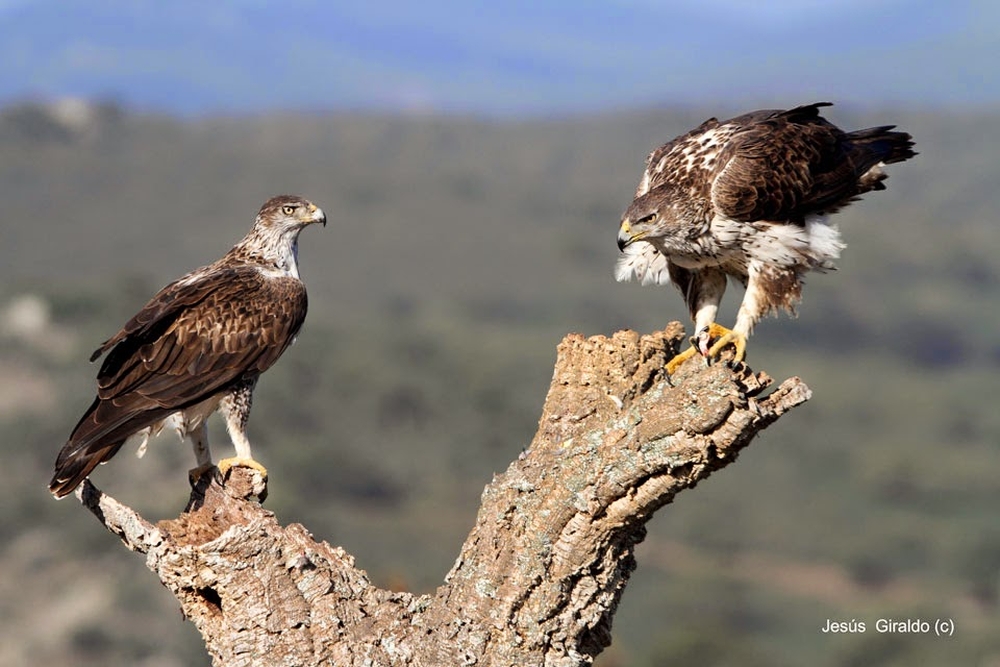
The first documented case of successful adoption of chicks from a nest of a pair of female Bonelli's Eagle in Spain
An Unusual Pair
Since 2022, biologists have been monitoring a nesting territory in the upper reaches of the Ebro River, where two female Bonelli's Eagles (Aquila fasciata) have established themselves. One of them (ring 583) arrived there at the age of two after killing a male (ring 552), who had previously occupied the territory with a second, four-year-old female (ring 179). Since then, the birds have formed a stable female-female pair, demonstrating typical pair behavior: cooperative hunting, territorial defense, and nest building and maintenance.
In 2024, the females laid two eggs, which were found to be infertile. In 2025, the situation repeated itself, but with four eggs (two from each bird). Two of them rolled out of the nest, and the remaining two were also infertile.
Operation Fostering
Using a unique opportunity, scientists from the species recovery program decided to introduce captive-born chicks into the nest.
In 2024, they replaced the two infertile eggs with a single 13-day-old female chick. The foster mothers accepted it in less than 8 minutes, quickly adopting and feeding it. The chick grew up successfully, fledged at 66 days old, dispersed 89 days later, and eventually settled in the province of Huesca, approximately 200 km east-southeast from its birthplace.
In 2025, the experiment was repeated with two male chicks, aged 12 and 15 days. They were also accepted with astonishing speed—in less than 12 minutes. Both young eagles successfully fledged (at 62 and 64 days), dispersed in early September (at 161 and 169 days), and subsequently settled in the Ebro valley, within the Gállego and Jalón river basins, approximately 168 and 156 km southeast of the nest.
Why Is This Important?
This case is more than just an anecdote. It has significant conservation value for several reasons:
-
Demonstration of an effective method. Fostering has proven to be a successful strategy for increasing reproductive success when natural reproduction is impossible. This could become an important tool in saving rare species.
-
Reduction of juvenile mortality. Chicks raised by wild parents have a much higher chance of survival after release than those raised in captivity. They learn to hunt and avoid danger in a natural environment.
-
Support for a small population. There is a shortage of males in the region. Maintaining this female-female pair helps retain a nesting territory and attract other birds (floaters), which is critical for the demography of the species in northwestern Spain, where the Bonelli's Eagle population is extremely small.
The researchers note that the success of the operation was made possible by careful planning, the use of nest cameras, GPS tracking, and close collaboration within the framework of the official recovery plan for the species (LIFE Aquila a-LIFE).
Possible Reasons for the Pair Formation
The authors suggest that the formation of such a pair may be due to a relative scarcity of males in the regional population or a lack of available territories for recruiting subadults. However, it is possible that female-female pairs among Bonelli's Eagles are more common than previously thought; they are simply difficult to detect without individual identification, genetic sex determination, and intensive GPS monitoring.
Brief Information about the Bonelli's Eagle:
This species is distributed from Southern Europe and North Africa to Southeast Asia. In Europe, its population has declined by nearly 30% over the past 50 years due to poisoning, habitat destruction, collisions with power lines, and disease. More than 700 pairs live in Spain, representing the bulk of the European population (approximately 1,100–1,200 pairs).
In order to leave a comment, you need to log in!