

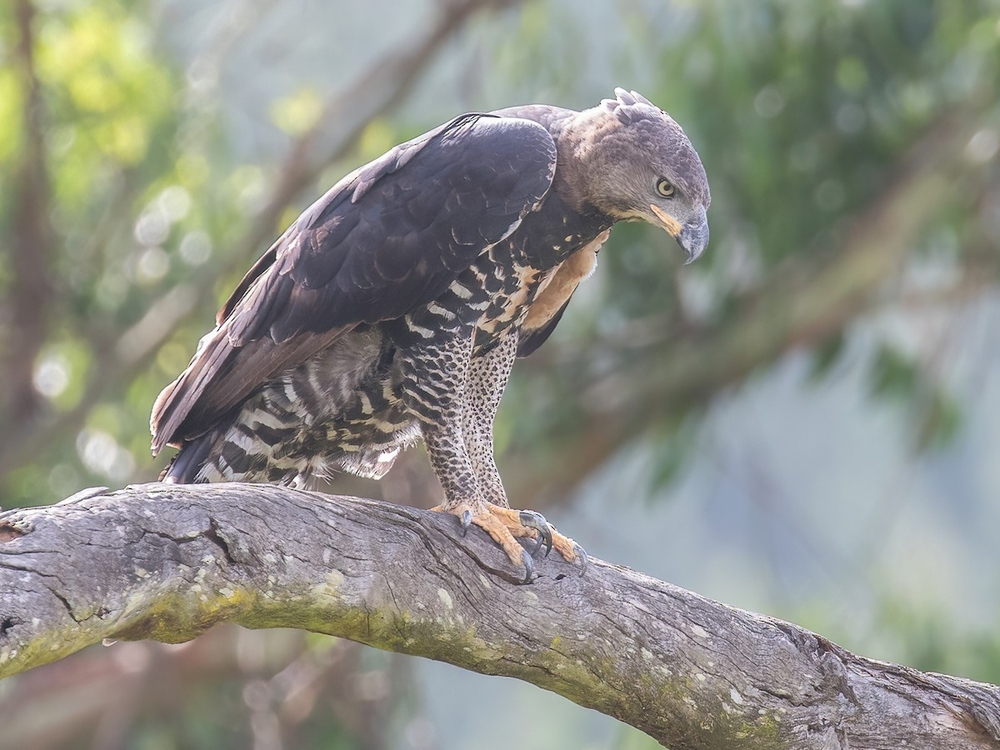
An Unusual Case of Nest Usurpation and Mixed Clutch
An Unusual Case of Nest Usurpation and Mixed Clutch: A Crowned Eagle Incubates Two Egyptian Goose Eggs Alongside Her Own
In 2025, a unique case of interspecies interaction involving the breeding of a crowned eagle (Stephanoaetus coronatus) was recorded in KwaZulu-Natal, South Africa. At a nesting site located on the Zimbali estate and equipped with CCTV cameras, researchers discovered the female eagle incubating a clutch of three eggs, two of which belonged to a Nile goose (Alopochen aegyptiaca) and one to the eagle itself. This is the first documented evidence of such a phenomenon for this species of raptor and one of the rare examples of mixed clutches in large raptors in the wild.
Crowned eagles typically lay one or two eggs, and due to obligatory siblicide (the killing of a younger chick by an older one), they only successfully raise one chick. The presence of three eggs in a nest is already an anomaly. The history of this particular site includes more than one conflict: back in 2012, after an eagle chick abandoned the nest, Egyptian geese took over the nest, laid their own eggs, and successfully bred, actively displacing the young eagle and throwing out the prey it had brought.
In 2025, events unfolded according to a different scenario, which was recorded in minute detail. In late July, two goose eggs appeared in the nest. The female eagle, upon returning, did not discard them, but began incubating them along with her own future egg, which she had laid a little later. About a month later, on August 30th and 31st, two goslings hatched from the goose eggs. The eagle showed no aggression toward them, but instead displayed parental behavior: she kept them warm and attempted to feed them, indicating the activation of general instincts to care for offspring that were not suppressed by the lack of specific cues. However, a fatal behavioral incompatibility soon emerged: the goslings, being precocial, were supposed to leave the nest within the first 24 hours, but the eagle instinctively held them close, delaying their arrival. One of the goslings nevertheless jumped from a height of 30 meters and survived. The second, however, remained in the nest and became increasingly active, but was eventually killed and eaten by the female when its behavior (climbing onto her back) no longer met her parental expectations. The eagle's own egg, despite continued incubation, failed to produce a chick, cracking at the proper time but showing no signs of life inside.
This case demonstrates that crowned eagles apparently lack an evolutionarily developed mechanism for recognizing the eggs of other species, at least taxonomically distant ones, and do not reject them during the incubation stage. The absence of typical raptor begging signals from goslings may have delayed their recognition as "foreign," but behavioral conflict in the later stages still led to the death of the brood. Furthermore, this study highlights the seriousness of the problem posed by the Egyptian goose as an aggressive invasive species capable of significantly impacting the reproductive success of native raptors, particularly in urban and suburban landscapes, where both species are adapting to human proximity. These observations highlight the need for long-term monitoring of nest competition and the development of management measures, particularly in regions where the Egyptian goose continues to expand its range.
Источник:
In order to leave a comment, you need to log in!