

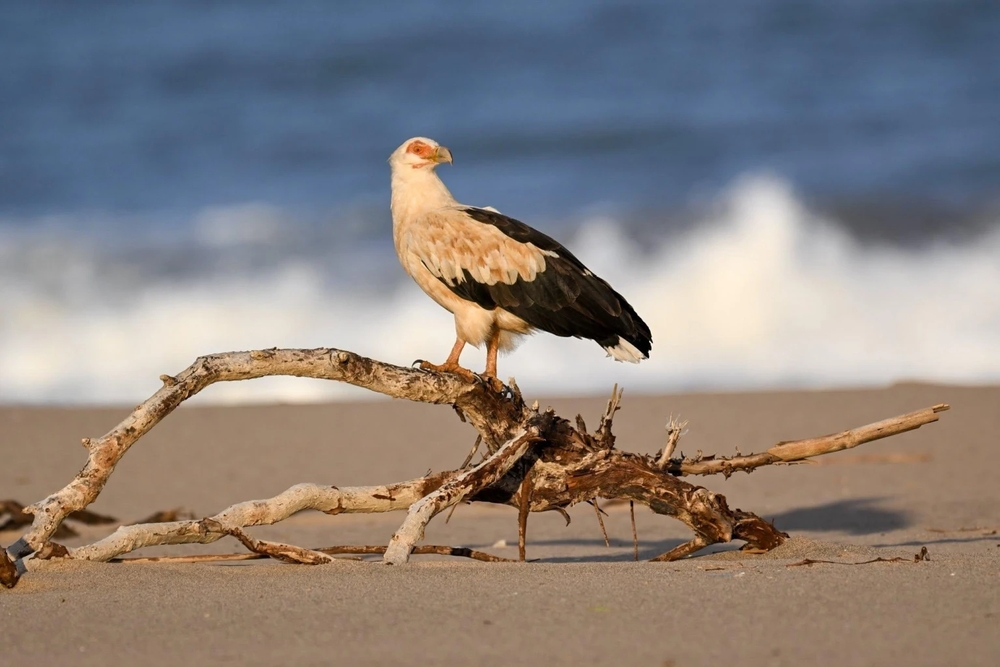
Palm-nut vultures successfully catch fish in the open sea
Palm-nut Vultures Successfully Catch Fish in the Open Seas of the Gulf of Guinea
The Palm-nut Vulture (Gypohierax angolensis) is one of the least studied species of African raptors, whose diet and feeding behaviour have long been the subject of debate. Unlike other vultures, this species feeds primarily on the fleshy pulp of oil palm and raffia palm fruits, but also consumes small animals, both as carrion and live prey. The question of whether the Palm-nut Vulture hunts live fish or only feeds on dead ones remained unresolved for decades. Earlier observations were fragmentary and often contradictory, with some authors suggesting that this bird may dive for fish like the Osprey (Pandion haliaetus) or even stalk prey like the African Fish-Eagle (Icthyophaga vocifer).
During fieldwork in Equatorial Guinea from January to March 2025, researchers obtained new data that significantly expand our understanding of the ecology of this species. The expedition covered 330 km on foot and over 2,000 km by car, during which 273 encounters with Palm-nut Vultures were recorded, including nine individuals observed fishing on two occasions. On 7 February 2025, off the coast of Bata on the Gulf of Guinea, researchers observed 19 Palm-nut Vultures (17 adults and two juveniles) flying over the open sea for two hours, approximately 150–400 metres from the shore, moving parallel to the coastline in a northeast to southwest direction. Eight adult birds dove over the water, and four of them emerged with prey approximately 20–30 cm in length held in their talons. The rounded shape of the captured prey suggested either juvenile sea turtles or, more likely, juvenile ocean sunfish (Mola mola), which form large aggregations in the area. The hunting method resembled that of the African Fish-Eagle, involving a sudden dive to snatch prey from the water surface, without the full submersion characteristic of the Osprey. Notably, none of the four failed capture attempts was followed by a repeat attempt, suggesting that the targets were alive and had moved out of reach.
The authors estimated the hunting success rate at approximately 50%, which is comparable to that of the Osprey—a fishing specialist for which published success rates range from 19% to 91% across different studies—and higher than that of the White-bellied Sea-Eagle (Icthyophaga leucogaster), whose success rate is approximately 39%.
These observations not only confirm that Palm-nut Vultures are capable of catching live fish in the open sea but also challenge the established notion that they are primarily frugivorous. The authors note that historically, this species was called the "Vulturine Fish-Eagle" until its current name, which emphasises its relationship with oil palms, was proposed in 1932. Recent phylogenetic studies show that Palm-nut Vultures are more closely related to birds of prey such as the African Harrier-Hawk (Polyboroides typus) and the European Honey-buzzard (Pernis apivorus), indicating a predatory origin for this group and the retention of hunting traits typical of diurnal raptors. Furthermore, the study documents for the first time that adult Palm-nut Vultures can carry fish in their talons for at least 1 km, whereas it was previously thought that they transported food for their chicks only in their crop or beak. This places them closer to other birds of prey in their method of prey transport.
The authors hypothesise that fish and other animal proteins may be an important nutritional component of the Palm-nut Vulture's diet, while carotenoid-rich palm fruits may serve not so much as an energy source but rather as a source of pigments needed for the yellow-orange coloration of the bare skin on the heads of adult birds. It is known that the closely related Egyptian Vulture (Neophron percnopterus) achieves similar skin coloration through carotenoids obtained from unusual sources. This hypothesis is supported by the observation that adult Palm-nut Vultures maintained in captivity on an exclusively meat-based diet do not develop the characteristic yellow head coloration. Thus, the study not only expands our understanding of the trophic niche and hunting behaviour of the Palm-nut Vulture but also opens new questions about the physiological mechanisms of nutrition and the role of carotenoids in the life of this species.
Source:
Photo: Renier Meyer
In order to leave a comment, you need to log in!